It is Sunday morning in Bhaktapur, the second day of Tihar, and I am writing this with a cup of tea while the house slowly wakes up. Tonight is Laxmi Puja, the brightest night of the year in Nepal.
I was almost not here. A few days ago I was planning a 16-day Annapurna Circuit for a small group of travellers, and for a moment I thought I would spend this Tihar on the trail. In the end the plan did not fit their budget, and that is okay. Life has its own itinerary. So this year I am at home with my father, my mother, my brother Ruman and his wife, and my nephew Ryan. But this is our first Tihar without Jessy, and one place at our door is empty. I want to share our Tihar with you the way I live it, and the way I miss Jessy.
What is Tihar?
Tihar is Nepal’s festival of lights. It is a cousin of Diwali in India, but with its own Nepali heart. It lasts five days and is also called Yama Panchak, the five days of Yama, the god of death. What I love most is that Tihar is not only about gods. It honours the crow, the dog, the cow and the ox, and at the end, the bond between brothers and sisters.
In 2026 the five days fall like this:
- Day 1 · Saturday 7 November: Kag Tihar, for the crows
- Day 2 · Sunday 8 November: Kukur Tihar, for the dogs, and Laxmi Puja in the evening
- Day 3 · Monday 9 November: Gai Tihar, for the cow
- Day 4 · Tuesday 10 November: Govardhan Puja and Goru Tihar, and Mha Puja for Newar families
- Day 5 · Wednesday 11 November: Bhai Tika
In most years Kukur Tihar and Laxmi Puja fall on different days. This year the lunar calendar put them together, so today is a long and full day.
Cleaning the house (and getting older)
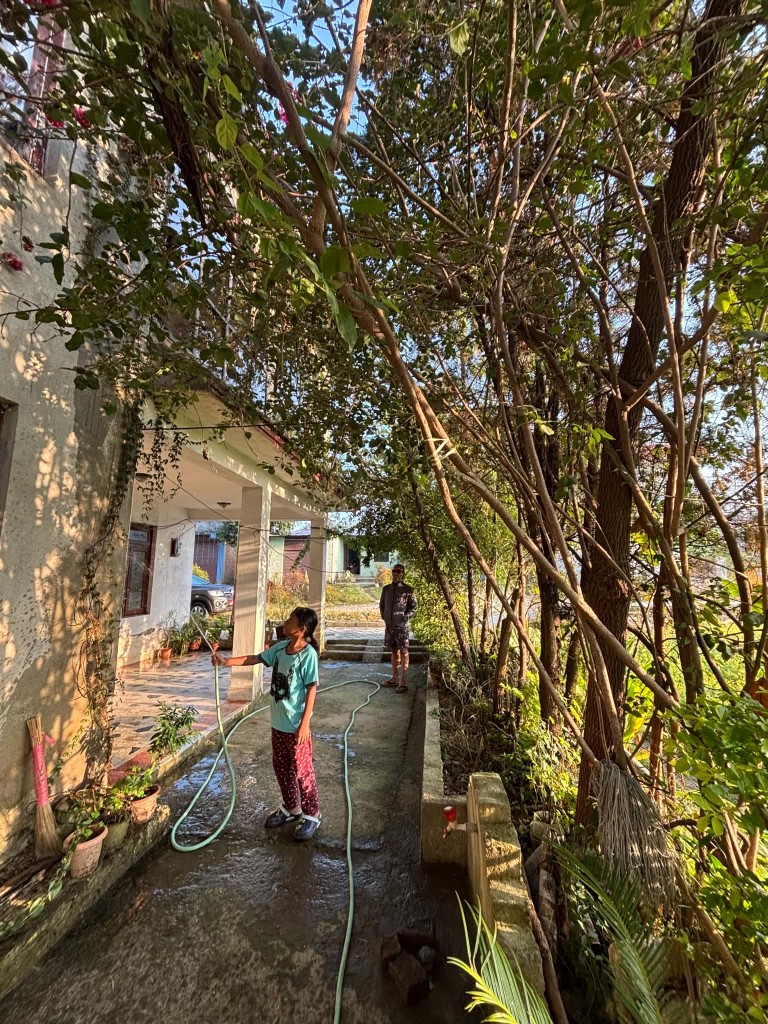
Before Laxmi, the goddess of wealth and good fortune, comes to visit, the house must be clean. I have cleaned most of it already, but I must be honest: every year I get a little lazier with the broom. Maybe it is age. Luckily, Ryan has more energy than all of us. This morning he took the water hose and washed the yard as if it was the most important job in Nepal, while my brother Ruman stood behind him, supervising.
Day 1: the crows, our messengers
Yesterday we worshipped the crow. In Nepali belief the crow is a messenger, and its call near the house can bring news. We put a plate of dal bhat on the round table on our rooftop terrace, and my nephew Ryan called the crows as loud as he could: “Ka, ka, ka!” We ask them to bring only good news this year.
Day 2: Kukur Tihar, and I miss Jessy
Today is Kukur Tihar, my favourite morning of the festival. Dogs get a red tika on their forehead, a marigold garland around the neck and the best food of the year. The dog is honoured as the loyal guardian of the house, and in our stories it is also the companion of Yama.
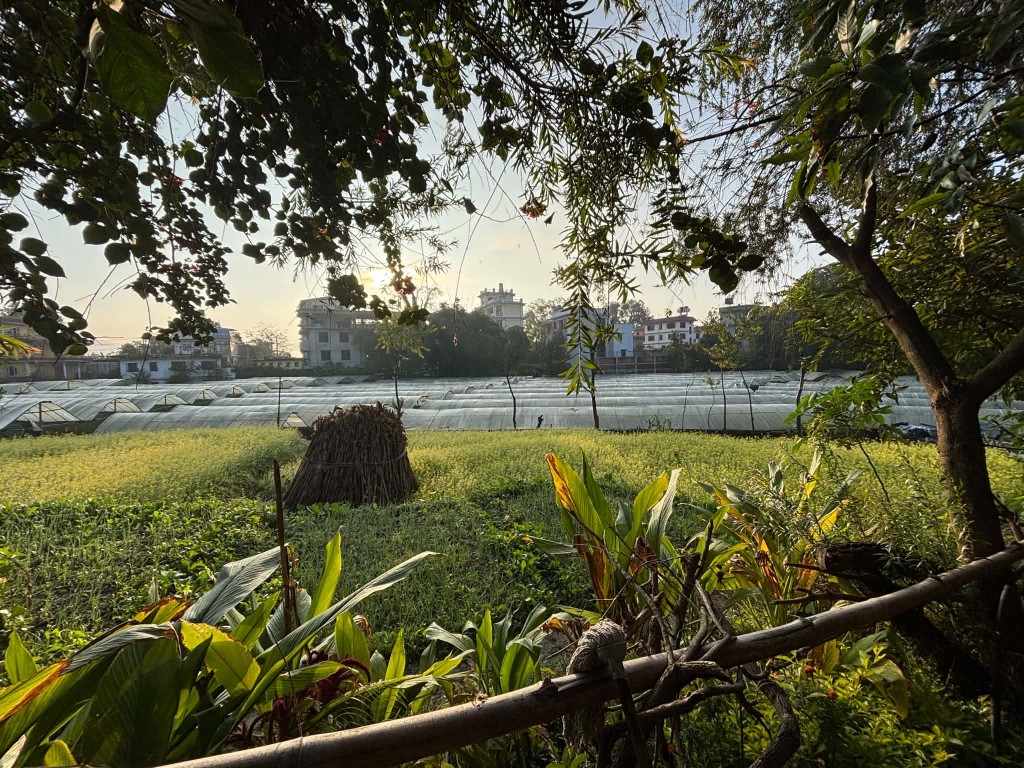
The funny thing is that when we came out with our plate, the dogs of our lane were not very interested. Since early morning, every family around had already fed them. So Fucchee and Kaale, the two dogs who always lie near our home, were stretched out on the warm path next to the mustard field, eyes closed, bellies full.
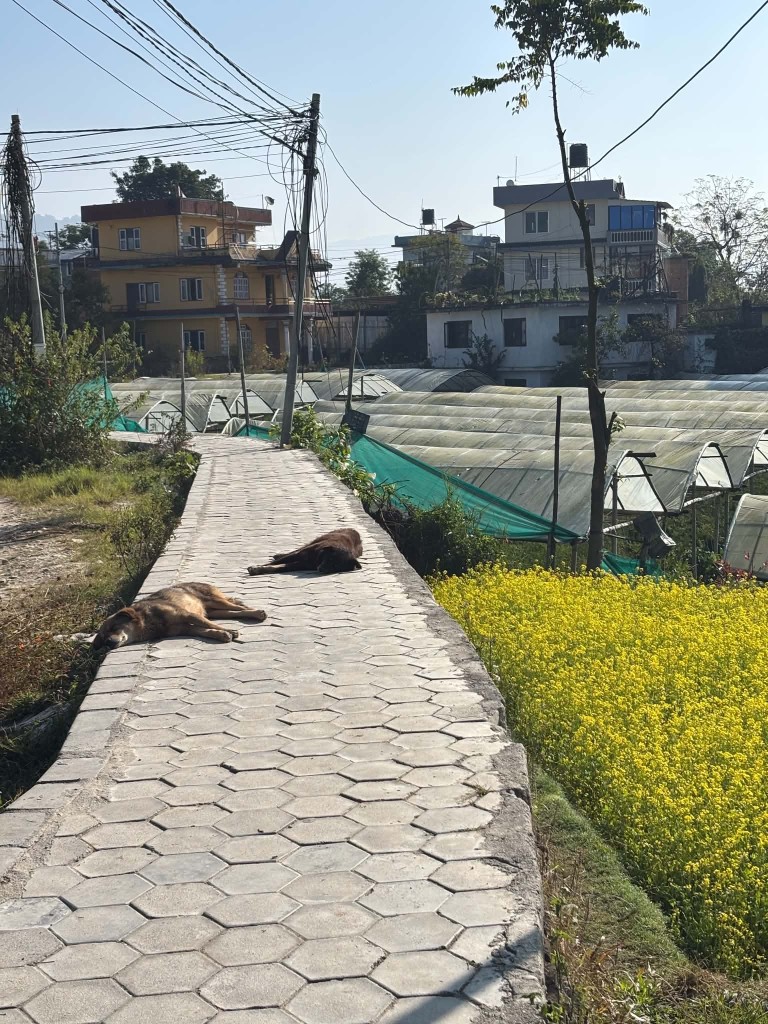
I watched them for a long time. They don’t need to save money for tomorrow. They don’t need big houses or nice cars. A full stomach, a sunny place and a little love is enough for them. They are real. And here we are, modern humans, carrying all our worries and plans. On Kukur Tihar, I think the dogs are the real teachers.
But this morning, I also missed someone. This is our first Tihar without Jessy.
Jessy came to us almost by accident. My cousin Binaya, on my mother’s side, was looking for a dog, and she was meant to go to his home. But my brother Ruman said, “Let her stay with us. Why should we take her to Binaya’s?” So she stayed, and for 15 years she was part of our family.
She could hear my motorbike from about 100 metres away. Every morning she said goodbye to me from the balcony, and every evening she waited there for me to come home. When I arrived, she ran down to the main gate, jumping and jumping until she had licked my lips. She never calmed down before that. At night she slept on the floor of my parents’ bedroom, but early in the morning, and sometimes even at midnight, she came downstairs to sleep in my room. She loved her morning tea with us. And she loved meat, but the meat our neighbour Pradeep Dai cooked for her she loved even more than mine.
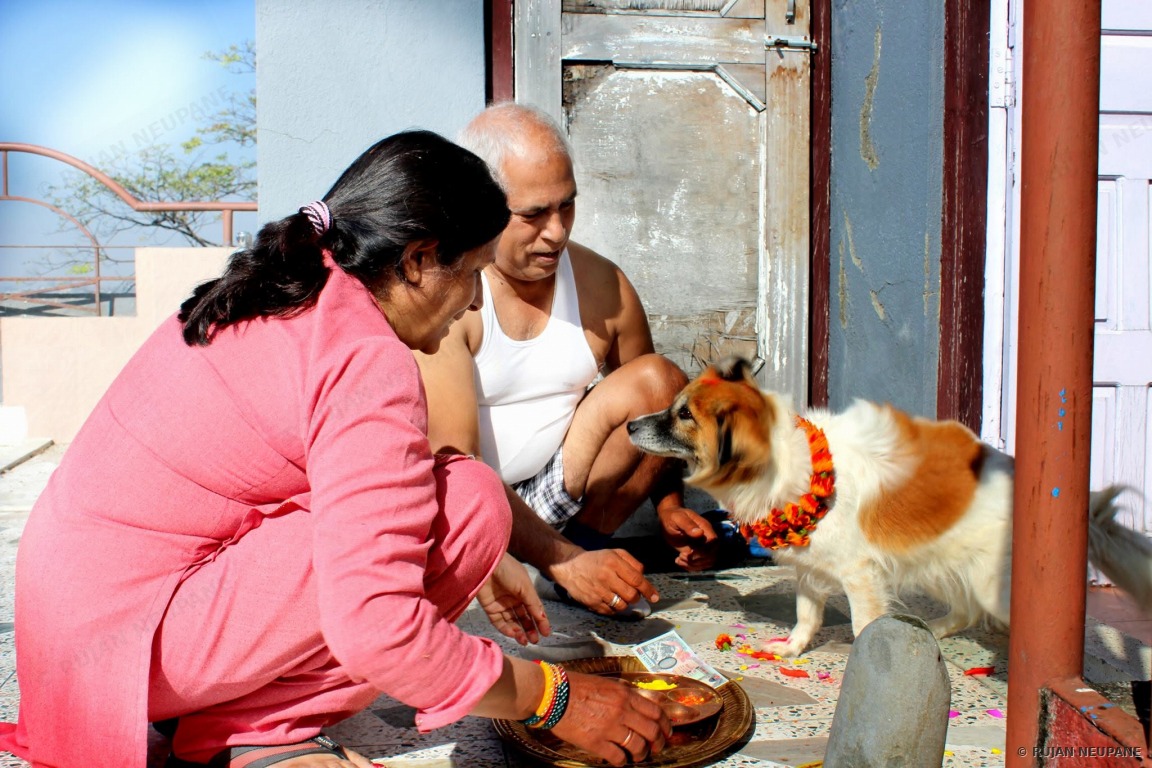
Every Kukur Tihar we worshipped her: a red tika on her forehead, a marigold garland around her neck, and her favourite food on a plate just for her. In my favourite photo of her, from 2016, she stands at our doorstep in her orange garland, while my mother prepares the puja plate and my father smiles beside her.
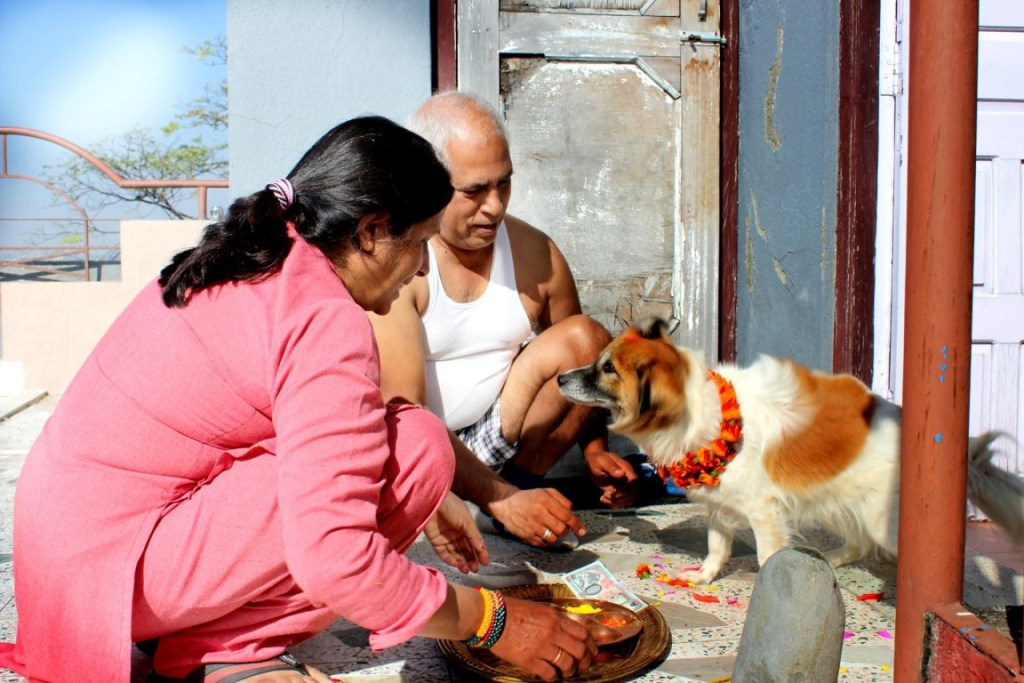
Last year, on 2 December, early in the morning at about half past six, Jessy died at home, in her favourite room, on her own bed. I cried a lot. Even now I remember her in every corner of our home, always, silently.
This morning I gave almost my whole cup of tea to Fucchee and Kaale. That was for Jessy. Dogs give us their whole life and ask for so little in return. Kukur Tihar is the one day we try to say thank you. Wherever she is, I hope Jessy knows how much we still miss her.
Flowers, mustard fields and my childhood
Our home sits at the edge of the village, between fields and greenhouses. At this time of year the mustard is in bloom, and the whole field behind our house turns yellow.
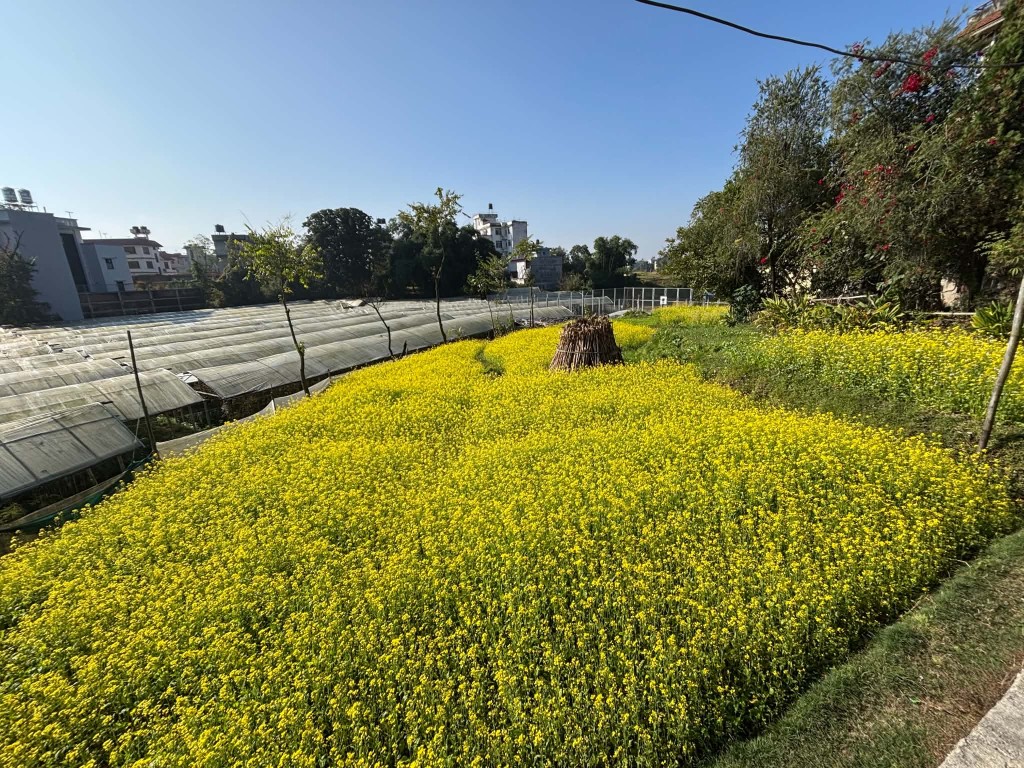
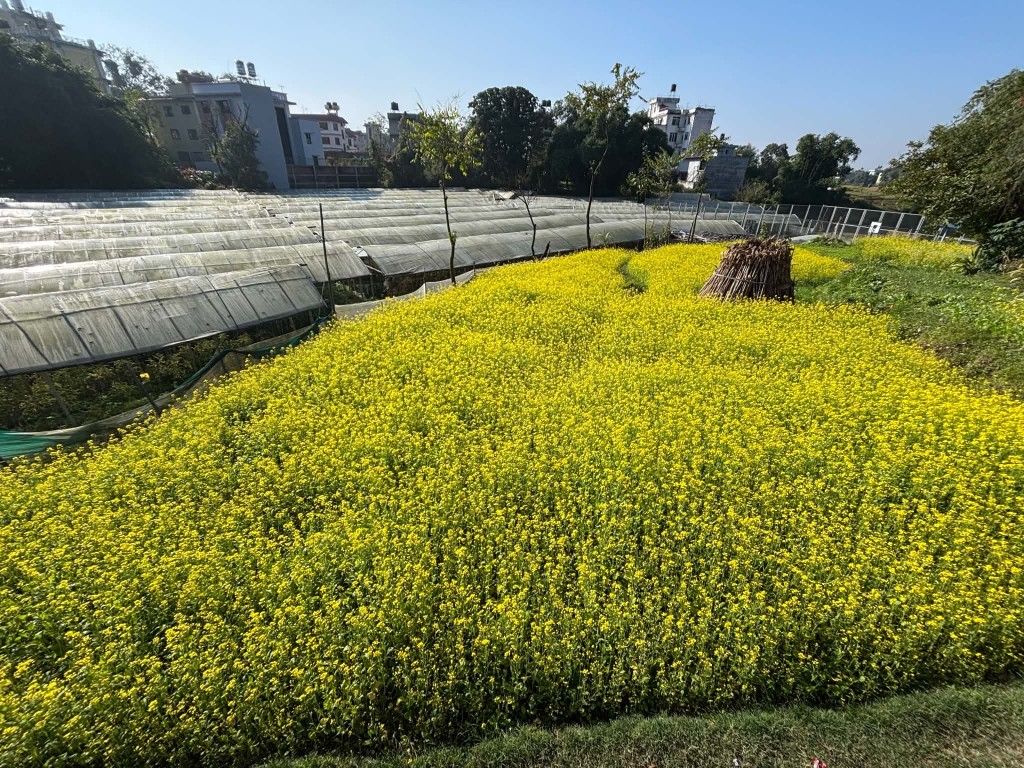
Around the house grow the flowers of Tihar: the godavari (chrysanthemum) in white and soft yellow, with a few pink heads of makhamali (globe amaranth) between them. When I bend down to smell them, I am a child again. I feel the fresh wind of the Kathmandu Valley as it was then, carrying the smell of the mustard flowers from the fields. I see our front yard again: the courtyard my mother plastered with cow dung and red clay, the pindi, our raised veranda, full of freshly harvested rice, and the whole courtyard covered with marigold and godavari.
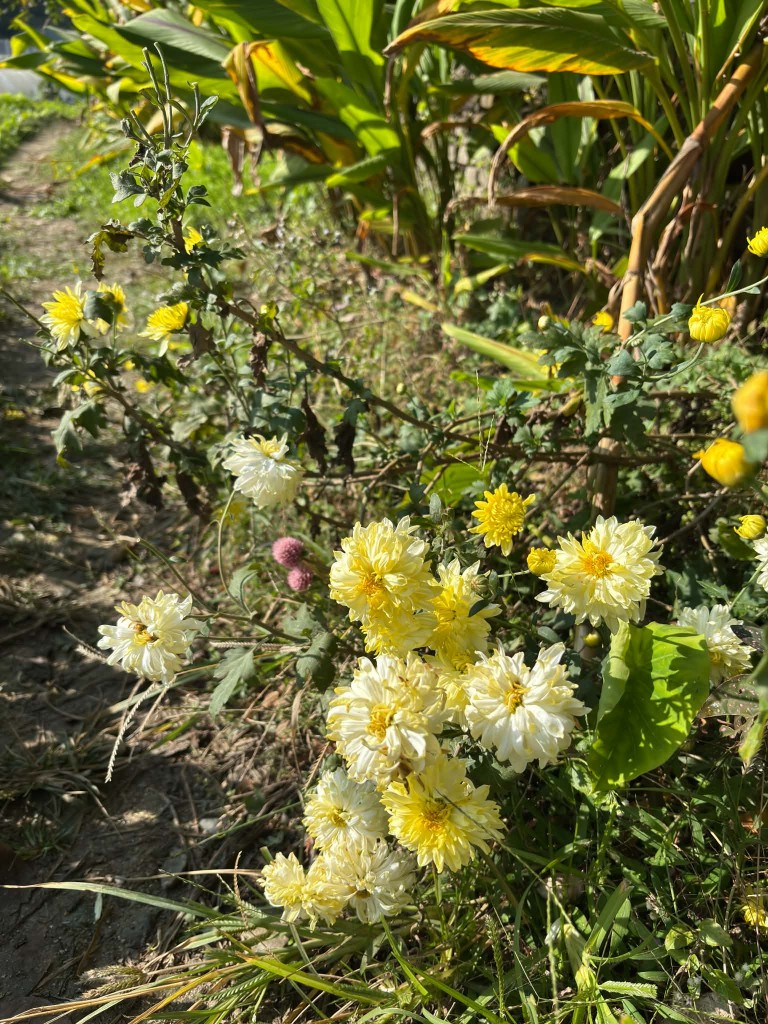


Each flower has its own job in Tihar. Marigold, sayapatri in Nepali, is everywhere: on doors and windows, on dogs and cows, and in the garlands for brothers. Makhamali is the special one for Bhai Tika. It keeps its colour for a long time without fading, so a sister puts it around her brother’s neck as a wish for a long life. Godavari blooms right in this season, so it goes into the garlands too. Not far from us, around Gundu near Suryabinayak, farmers grow makhamali in whole fields, mostly for this one day of the year.
In my childhood, my brother and I spent the best days of Tihar in Baneshwor, in the city. Our cousin sister, Sabitri Didi, took us there after the school holidays. Our place in Bhaktapur was a small village then, quiet and dark at night. In Baneshwor there were lights on every house, and the sky was full of firecrackers and rockets. We just stood there and stared. My own memories start when I was about ten, but I am sure Sabitri Didi took us there even before I can remember. She had such a beautiful heart. Ryan, the boy with the hose, is eight now, and today I see the same happiness in him.
Laxmi Puja: the night of lights
Tonight, when the sun goes down, we light the diyos, the small clay lamps with cotton wicks and oil. They are already waiting on two round bamboo trays, our nanglo, on the bench beside the old stone grinder.
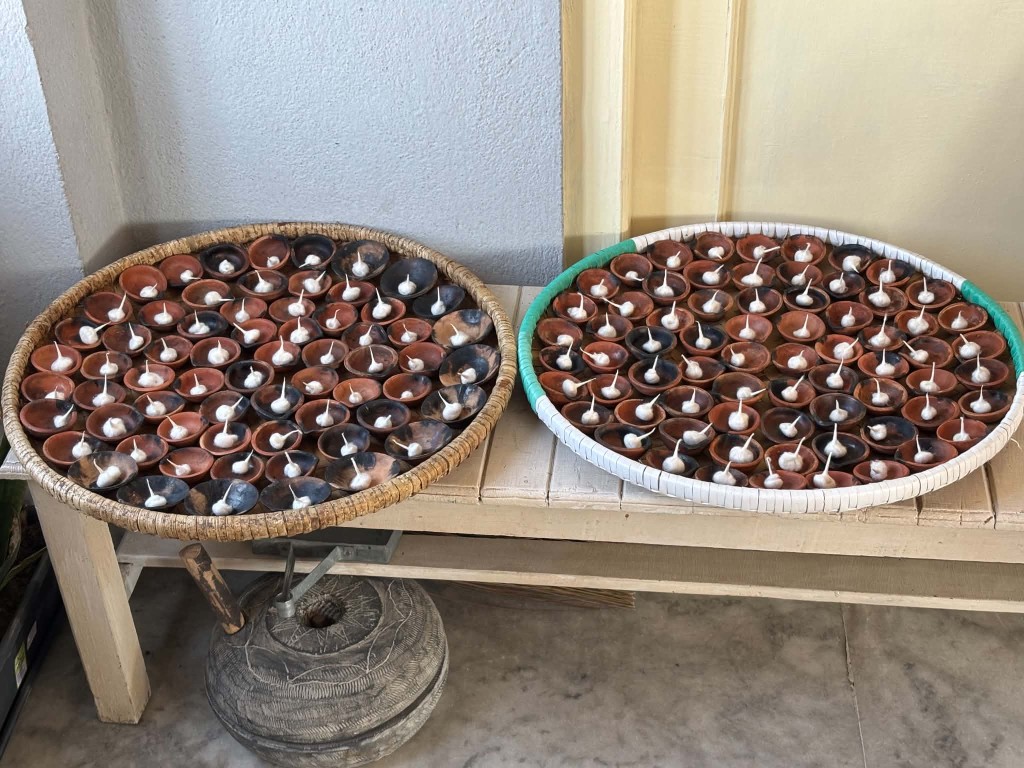
The door and windows are dressed in marigold garlands, orange and red.

Before the puja begins, my mother fries the Sel. Usually she also does the puja to Laxmi. This year my brother’s wife is fasting, so tonight she may lead it. Then we place the lamps on the doorstep, the windows and the walls, so that the goddess can find her way into our home. Slowly, all of Bhaktapur fills with small flames. Later I go up to our rooftop to watch the whole valley glow.
Day 3 and Day 4: cows, oxen and the Newar new year
Tomorrow morning is Gai Tihar. The cow is Nepal’s national animal and a symbol of Laxmi herself, so she gets tika, garlands and fresh grass. We stopped keeping cows at home nearly 12 years ago, so now I see the cow puja in our neighbourhood.
The day after is Govardhan Puja, also called Goru Tihar, when the ox is honoured for its hard work in the fields. For Newar people this day is even more special. It is Mha Puja, the worship of one’s own body and soul, and it is also the first day of the new year in the Nepal Sambat calendar. My family doesn’t celebrate Mha Puja, but every year on this day I walk into the old city of Bhaktapur with my camera. I was born and raised here, so I know which courtyards to step into and when to stay quiet. If you are in Nepal at Tihar, this is the day I would love to walk Bhaktapur with you.
Day 5: Bhai Tika with my cousin sisters
I don’t have sisters of my own, but I have three elder cousin sisters, and two of them live here in Nepal: Laxmi Didi and Sabitri Didi. On Bhai Tika I go to them in Sundarijal, at the edge of the valley. They put the seven-coloured tika, saptarangi tika, on my forehead and a makhamali garland around my neck, and they pray for my long life. Then comes the tika masala, the dry fruits and sweets every brother receives, and a long, late lunch. After lunch we sit together and play cards, marriage, kitti or chali farash, with paan in our mouths, laughing until the evening.
I must confess something: our tikas are never perfect. I see other people with beautiful, neat tikas on their foreheads, and ours always look like a happy accident. We try every year. Maybe next year.
And of course there is Sel, the ring-shaped sweet rice bread every Nepali home fries for Tihar, together with sweets and dry fruits. I am vegetarian, so for me this is the real festival: sweets, dry fruits, flowers, and worship for dogs and other animals.
Deusi and Bhailo
In the evenings of Tihar, groups of young people go from house to house singing Deusi and Bhailo songs. They bless the household and receive money, Sel and fruit in return. As children, my brother and I were too shy to go out and sing. Today only one or two groups come to our house, even fewer than before. Times change, even for festivals.
Tihar for travellers: a photo walk with a local
If you are in Nepal during Tihar, it is one of the most beautiful times to walk with a camera. Here is what I tell my guests:
- Go up at night. From any hill around the valley, or from Swayambhu, you can see the whole of Kathmandu glowing on Laxmi Puja night.
- Walk in Newar neighbourhoods. Patan, Bhaktapur and smaller towns like Khokana are full of small rituals at the doorsteps, if you walk slowly enough to see them.
- Photograph the dogs on Kukur Tihar. With their tika and garlands, they are the happiest models in Nepal.
- Never photograph people without asking. A smile and “Photo khichna milchha?” (“May I take a photo?”) go a long way. During a puja, keep a respectful distance.
- Walk with a local guide if you can. I can be the bridge between you and the families, so you are not a stranger with a camera but a guest.
For a Tihar day with me, I like to start in a Newar settlement like Khokana, walk the old lanes of Patan in the afternoon, and end on a hill above the city when the lights come on. It always depends on what my guest loves most. If you have one more night, we can stay in a village nearby and feel Laxmi Puja as it is celebrated outside the city: quieter, simpler and very real.
What Tihar means to me
For me, Tihar is gratitude: to the crow, the dog, the cow and the ox, to my family, and to the light that comes back every year after the darkest night. This year it is also about Jessy, and about saying thank you to someone who is no longer here.
When I guide, I don’t sell a package. I share the Nepal I grew up in: the courtyard my mother plastered, the crows Ryan calls from the rooftop, the lanes of Bhaktapur on Mha Puja, and the memory of a dog who waited at our door for 15 years. If you would like to feel Tihar like this one day, on a city walk or a photo walk, write to me. I would be happy to walk with you next year.
Happy Tihar from our home in Bhaktapur.
— Rujan