I have just come back from nine days on the trail: Poon Hill first, then Annapurna Base Camp, with three young walkers, one from the Netherlands and two from Australia, and two porters. Before the memories fade into the next trek, I want to write down what a day really looks like for the person walking behind you. Not the brochure version. Mine.
5:30: before you wake up
On a normal trail day I wake at about half past five. On the day of a high pass it is much earlier: we start between three and half past three, in the dark.
The first thing I do is look at the sky. My eyes are still my best weather forecast; my phone comes second, and only if there is network. Then I go to the lodge kitchen. Breakfast is usually ordered the night before, so I check that it is coming, mostly between half past six and half past seven.
Where did I sleep? Usually in a shared room with other guides and porters. Higher up, when the lodges are full, I sleep on a bench in the dining room, with a blanket from the lodge. Guides do not open sleeping bags there. The nights are cold, and they are short.
The first hour with you
When my guests come down, I greet them with a very happy “Good morning!” Then I look at their eyes. Tiredness, a bad night, the first signs of altitude: they all show in the eyes before people say anything. I ask how they slept, and I listen carefully to the answer.
On the trail: I walk behind you
I always walk behind my guests. From there I can see how everyone is walking, who is slowing down, who is breathing hard, who needs a stop but is too polite to ask.
About an hour after breakfast we stop to drink water; if guests carry sachets of energy powder, I ask them to add one. We stop again before every steep climb. Two hours after breakfast I like a cup of tea, and if my guests want one too, we stop.
I walk a little slowly on purpose. I am not a nature guide, but I like to watch. On this trek we saw langurs in the trees and a beautiful waterfall, and the forest was full of birdsong all day.
In the first days I talk a lot: about the trail, about who I walked it with last time, about my guests’ lives beyond walking. Later in the trek I talk less. On the way back down the same trail, not everyone wants to talk, and silence is part of a good walk too.
Three tall walkers and a mountain
My three guests this time were about twenty-seven, very tall, and very fast. They talked about record times. I asked them to slow down; their long legs did not listen.
Above Deurali I began to worry. They were strong, but they did not know mountain trails, and altitude does not care how strong you are. So I asked again, more firmly: slower, and carefully along the cliffs. That is the job. Not to be liked every minute, but to bring everyone back.
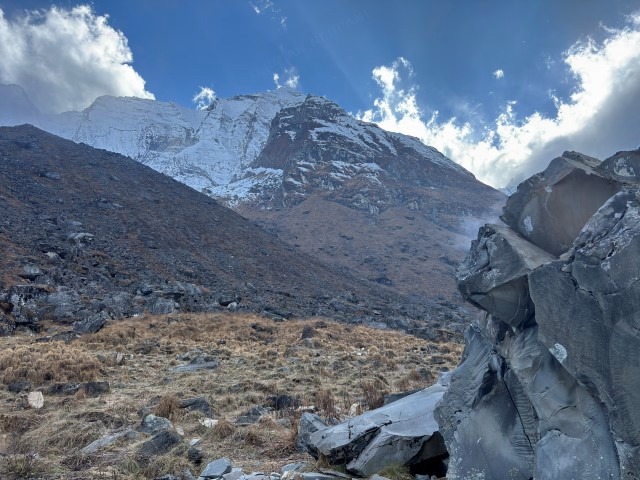
Down in the dense green forest below Deurali, they had told me they did not believe we would reach snow. At Machhapuchhre Base Camp we stopped for tea. The sky was completely clear, the sun was warm, Machhapuchhre stood in front of us, with Hiunchuli beside it and the Gangapurna range behind. My guests went quiet and simply looked. It was something completely different from anything they had seen. That tea was the best moment of my whole trek.
Annapurna Base Camp
We reached Annapurna Base Camp, 4,130 m, around noon, hungry, in perfect soft light. There was a queue of people waiting to photograph the famous sign. We waited too. My honest advice: take one good picture with a big smile, then let the next person have theirs. If you want to pose, find a corner. The mountains are all around you, not only behind the sign.
We saw both sunset and sunrise there. In the morning I let my guests walk alone. They needed some free time, and I had already seen fine sunrises with them at Poon Hill. I walked around by myself. It was cold, but not extreme. When the first rays touched Annapurna, I felt very calm.
Lunch: you eat first
We try to eat lunch before one o’clock, though often it is later. I take my guests’ orders first. When they have eaten, the kitchen gives the guides our food.
Here is something guests never see. I pay for my meals on the trail from my own salary. Yet in many kitchens guides are treated as if we eat for free: last in line, at a narrow table, dal bhat again. For me it is a little harder, because I am vegetarian. Everyone is happy with chicken; I love an omelette, but most kitchens do not want to fry one for a guide. They hesitate, and at the end a small omelette arrives.
While my guests rest in the afternoon, I often double-check our rooms for the night. Booked rooms are not always safe. On an earlier trek near Landruk, our lodge gave our rooms to a group who had come for honey hunting. We walked on and found a small home that looked like a lodge, far along the trail. The man there welcomed us so warmly and served us dal bhat beautifully, with phapar roti and a local green I still cannot name. I have not forgotten him.
Evening: the stove, the map and the kitchen
Evenings in a tea house are what you imagine: everyone in a circle around the heating stove, socks drying, cards, stories. Dinner is ordered before five. My favourite moment of every day is that evening hour in the dining room with a warm cup of tea, when we get one.
After dinner, sometimes before, I brief the next day. I still use a big paper map on the table. On this trek the Dutch walker loved it; I think his generation grew up with maps on phones, and a real map with a finger tracing tomorrow’s trail was something new.
And then dinner, where the system shows itself. Almost every guest I have walked with wants to eat with me. From the first day, most of them see me as a friend. The trails are not a luxury hotel, and nobody comes to the mountains to be served like a king or a queen. But the custom on the trails is that guides eat separately, in the kitchen, with the other guides. We talk and share our stories from the trails, and I enjoy that. But I would rather play cards with my own guests, and eat with them too.
After dinner I sleep straight away if I have a bed. If not, I wait until the dining room empties. It is hard: no space to sort my bag, and I carry the cash for every day of the trek, so I sleep with a small bag on my body.
What guests never see
- The kitchen. We ask, and ask again, for your food to come on time, and we cannot complain there. We are restless until your plates arrive.
- Our food. You eat well, and we are happy you do. We eat dal bhat at a narrow table, smelling cheese and spices from the dining room.
- The nights. A shared room, or a bench and a blanket.
- My camera. I carry it every day, about nine kilograms in my bag with my clothes, my own pulse oximeter and my own first-aid kit. I rarely have time to photograph for myself, but a few good frames make me happy. At altitude a camera is very heavy.
I have never faced a truly serious emergency on the trail, and I hope I never do. But I am ready every day. I watch faces and breathing, I check oxygen levels with my oximeter when something looks wrong, and I know where we will go down if we need to. If someone’s body says stop, we stop, and if it says go down, we go down. No summit is worth more than a person.
Why I do this
Before 2018 I was an event photographer for six years: weddings, pasni rice-feeding ceremonies, maternity shoots, bratabandha. I started walking the trails for myself. And I wanted to talk with people from all over the world. The only way I could do that was to become their guide. So I did.
My first trek as a guide was Tsho Rolpa, with a guest from the USA. He was flexible: we stayed one extra day in Beding and one extra day in Na. One clear evening in Beding he said, “Rujan, this is heaven.” The lake was half frozen and the sky was clear. From him I learned that you enjoy a trek only when you are flexible beyond the routine. A routine trek is not a real experience of nature.
Another guest changed me too: a photographer from Norway, with whom I walked twenty-three days in the Everest region this March. He taught me to read light, even in fog, and to prepare before everyone else does: to be in the line of light early, to find the place before the crowd. I use those lessons on every walk now.
My family is not truly happy inside. Mountains are not always safe, and my mother worries most. On the trail we can rarely connect; I tell her only the day I am coming home. My father also loves meeting people from around the world, so he understands.
Coming home
When I come home, I go upstairs to my parents’ room and look in the mirror to see how much the sun and snow have burnt me. Sometimes my mother says, “Too much this time.” Sometimes she says, “Not so bad.” And then dal bhat at home, which is always the best dal bhat in Nepal.
One human, one feeling
I am not writing this to hurt anyone. Lodge owners work hard in hard places, and I want them to keep earning. But the system on the trails needs to grow with the times. Guides and porters are people who pay for their food, walk the same trail and feel the same cold. Food for all, sleep for all, dignity for all. To the lodges, I only ask: please stand in our place for one evening, and think how it would feel to you. I hope the big companies and the Tourism Board help train lodges in this new way.
And there are a few small things you can do as a guest:
- If you would like your guide at your table, just ask, and ask the lodge too. Most guides would love to.
- Order your meals early, so the kitchen is not rushed and your guide is not caught between you and the cook.
- Learn your porters’ names and thank them. Ram Dai, who carried for us on this trek, had the kindest smile I have ever seen on a trail. I cannot explain it in words; you would know if you met him.
Despite everything, I love this life. I am happy, and I am satisfied. If you would like to walk with someone who walks behind you, watches your eyes in the morning, and would happily share your dal bhat, write to me.
Read more: teahouse life, porters in Nepal, tipping your guide and porter and altitude sickness on Nepal treks.