I’m Rujan, a licensed trekking guide living in Kathmandu. I walk to Annapurna Base Camp often, and the question I hear before every trek is the same: what will it really cost? I do not sell packages. I charge my guide fee, and everything else you pay at its own price, to the people who give you the service. So here is the trek the way I see it, line by line.
The parts of the cost
A trek to Annapurna Base Camp from Kathmandu usually takes 9 to 12 days. The cost has five parts: the guide, the permit, getting to Pokhara and the trail, the lodges and meals on the way, and the small extras. Only the first is mine.
1. The guide
Since April 2023 foreign trekkers in the Annapurna Conservation Area are meant to walk with a licensed guide (see the licensed guide rule). My fee is one day rate for your whole private group of 1 to 5 people, for every day we are away from Kathmandu. It is the same rate for one person or five, so a group shares it. You find the rate on my write to me page, or I send it when you ask.
A porter is your choice. A porter carries the heavy bag for a day rate paid to him; see porters and fair treatment and tipping your guide and porter.
2. The permit
One permit is needed: the Annapurna Conservation Area permit (ACAP). For foreign visitors it is NPR 3,000; for visitors from SAARC countries NPR 1,000; children under 10 do not pay. You pay the official price and nothing more. See the ACAP permit.
3. Getting there
- Kathmandu to Pokhara: a tourist bus (the cheapest, about 7 hours), a private car or jeep (I have paid about NPR 12,000 one way), or a 25-minute flight. See Kathmandu to Pokhara.
- Pokhara to the trail: a jeep to Nayapul, Kimche, Siwai or another road end, shared or private. The price is agreed with the driver before we go.
- Back: the same, in reverse.
4. Lodges and meals
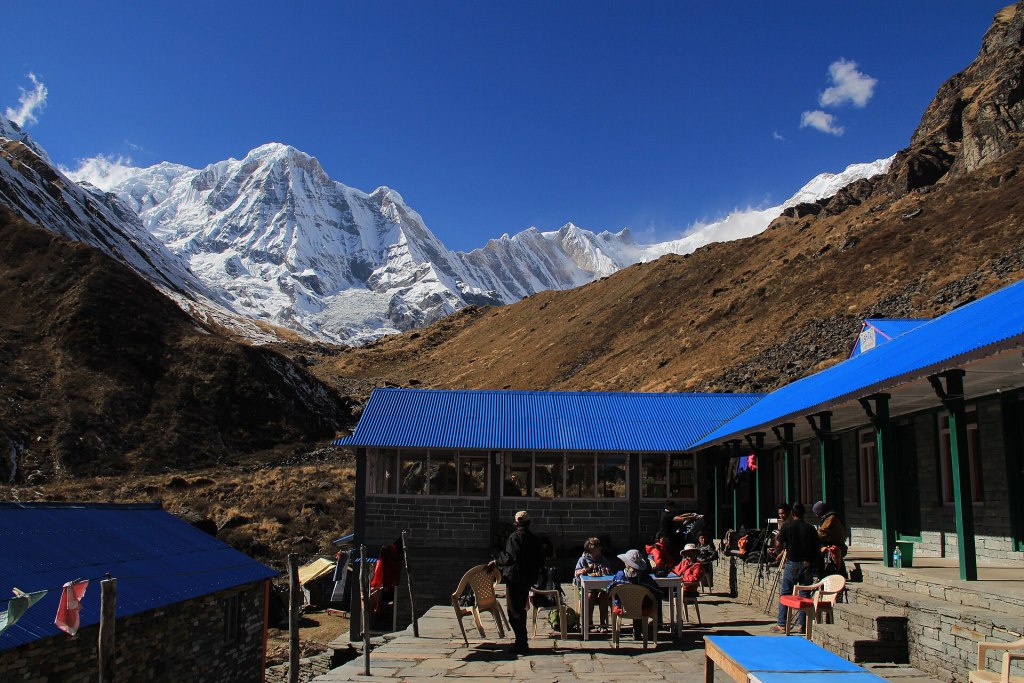
This is the biggest part after the guide. On the ABC trail you sleep and eat in family lodges. Rooms are cheap, sometimes very cheap if you eat dinner and breakfast where you sleep; the food is where the money goes. Prices rise as you climb, because everything above Chhomrong is carried up by people and mules. Dal bhat, with free refills, is the best value on every menu.
You pay the lodges directly, in cash. I never add anything to their bills.
5. The small things
- Hot showers: often charged separately higher up.
- Charging your phone or camera: often charged by the hour or by the device, more as you climb.
- Wi-Fi: some lodges sell a card; it is slow.
- Drinking water: refill and treat it; bottled water costs more every day you climb, and leaves plastic behind.
- Snacks, chocolate, tea, and the odd beer at the end.
- Tips for your guide and porters, a real part of their income.
There are no cash machines on the trail. Take enough rupees from Pokhara, in small notes. See money on a trek.
How to keep it lower
- Share the guide: one rate for up to five people.
- Take the tourist bus to Pokhara rather than a flight or private car.
- Eat dal bhat, drink tea, and treat your own water.
- Charge from a power bank you filled in Pokhara.
- Do not cut days to save money. A rushed climb is the expensive kind if someone gets sick.
What I never do
I do not sell a package with one big price, and I do not add a commission to lodges, jeeps or permits. Before the trek I send you every price I know, by email, so you can see where your money goes. For a day on the trail in general, see a day’s real costs on the trail.
Rules change. If something here is out of date, please tell me and I will correct it.Tell me
Sources
- ACAP fees and where to get the permit (operator guide) keitreks.com
- Annapurna Conservation Area Project (NTNC) ntnc.org.np