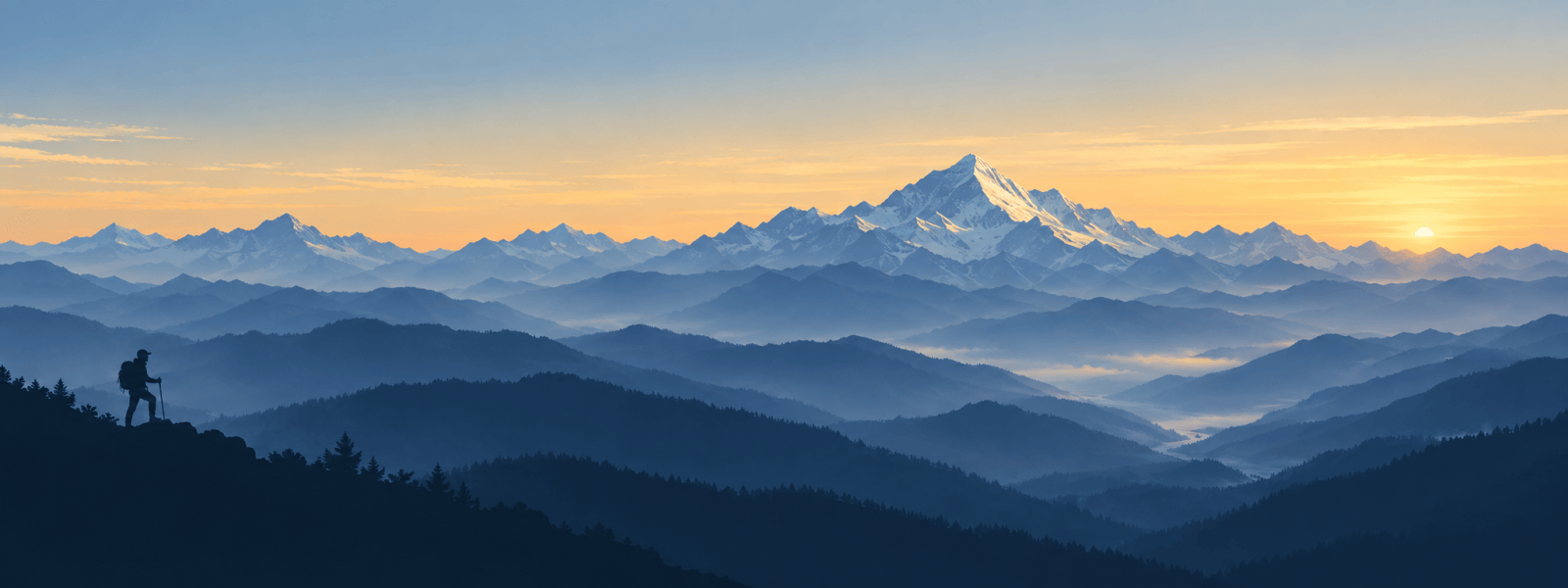
I came to the mountains with a camera before I came as a guide. For years I thought I was chasing views. Slowly, walk after walk, I understood that I was chasing something smaller and quieter: the light.
A mountain is the same mountain all day. The light is what changes it.
The first light belongs to the highest places
On a clear morning in the Himalaya, the sun doesn’t arrive everywhere at once. It touches the very top of the highest peak first, a small point of gold, while the valley where you stand is still dark and cold. Then, slowly, the gold moves down the snow.
I have watched this many times from Kyanjin Ri in Langtang, and from other hills before dawn. It still makes me quiet. It feels like the mountain is being woken up gently, one ridge at a time.
I think there’s something in it for us too. The light doesn’t rush. It comes down at its own pace, and nobody can hurry it.
A sunrise with no mountains at all
People are often surprised when I tell them one of my favourite sunrises has no snow peaks in it.
In Chitwan, in the winter, a thick fog lies over the plains in the early morning. The sun rises out of the flat land, round and soft, and you can look straight at it through the mist. The trees appear one by one. The river is silver. Everything is still.
After years in the high mountains, this taught me that beauty is not only in the big, famous places. Sometimes it’s in the plain things: a field, a river, a morning that asks nothing from you.
The evening someone called me outside
In Phortse, a quiet Sherpa village across the valley from the busy Everest trail, one evening a guest came into the dining room and called me outside.
I went out, and Ama Dablam was glowing in the last light of the day.
It became my most beautiful photograph of that trek. But what I remember more is that someone else saw it first and wanted to share it. As a guide, I’m used to showing people things. That evening, I was the one being shown.
I think about that often. Sometimes the best thing I can do on the trail is to stop guiding and just look, together.
The sky beyond the Himalaya
In Upper Mustang and Upper Dolpo, the places I love most, the light is different again. There is so little cloud and so little dust in the air that the sky is a deep, almost dark blue. The red cliffs, the white chortens and the dry gold earth stand out so sharply they look painted.
There, the light teaches me something about emptiness. A land with almost nothing in it can be the fullest place I know.
Why I walk slowly now
When I was younger, I wanted to arrive. The pass, the base camp, the viewpoint: those were the goals.
Now I know the light doesn’t wait at the top for you. It happens everywhere along the way: on a stone wall in a village at four o’clock, on the face of an old woman turning a prayer wheel, on the steam from a cup of tea in a cold teahouse. If you walk fast with your eyes on the next stop, you miss most of it.
So I walk slowly, and I ask the people who walk with me to do the same. Not only because it is safer at altitude, though it is. But because the slow walker sees more.
A small practice
If you come to Nepal, try this once. One morning, wake before dawn, sit somewhere quiet with something warm to drink, and don’t take a photo for the first ten minutes. Just watch the light arrive.
Then take your picture, if you still want to. I think it will be a better one.
If you’d like to walk slowly with me, write to me. I’ll help you find the mornings and evenings that are worth waiting for.