Some days as a guide are about mountains. This one was about a city, or rather three very old places in one valley, and five travellers from Canada who saw them with fresh eyes.
There were four women and one man. They had just spent eleven days in Bhutan before flying to Nepal, and that same morning they had already been up before dawn for the early mountain flight to see Everest from the air. By the time they came down to the lobby, they had tired eyes and big smiles.
Ten o’clock, Kathmandu Guest House
I met them at the Kathmandu Guest House in Thamel, and we started at ten. Before we left, we sat together in the hotel lobby, and I told them, more or less, what I tell every guest on the first morning:
“A very warm welcome to Nepal. I am truly honoured to be your guide and companion today. I know you have travelled a long way, all the way from Canada, to be here. I may not speak the most perfect or fancy English, but I bring you something straight from the heart: the warmth, peace and blessings of our Himalayas.
Nepal is not just high mountains and old stone temples; it is a land of deep spiritual energy. I don’t want to overload you with dates and heavy history. I want you to feel this place: the calm breeze, the sound of prayer flags, the peaceful spirit of these hills. Take your time, walk at your own pace, and if you are ever tired or have a question, I am right here beside you.”
I did not say every word of it; I never do. But that is what I mean every time. I may not have fancy English. What I have is a straight, honest heart from the Himalayas, with peace inside and love to share. On a day like this, that is enough.
Kathmandu through a van window
The first lessons of the day came before we even arrived anywhere.
On the road out of Thamel, they pressed close to the windows of the van. A man was riding a bicycle loaded with long metal rods, balancing them through the traffic as if it were the most normal thing in the world. “We saw exactly the same in Rwanda,” one of them said, and they laughed. Travellers often find that the world is more connected than they expected: the same clever, hard-working ways of carrying life forward, on different continents.
Then they noticed the electricity poles, with their famous tangles of black wires hanging in loops and knots above the streets. They could not stop looking. To us in Kathmandu, they are just part of the city; to a visitor, they are a wonder and a puzzle: how does any of it work?
Bhaktapur: a city that still lives in its old streets
Bhaktapur, the old city of the Newar people, is one of the three royal cities of the Kathmandu Valley, and its Durbar Square is a UNESCO World Heritage Site. Walking in, you feel time slow down: red brick, carved wood, temples standing in open squares, and people living their everyday lives among them.
My guests loved simply walking and watching: the courtyards, the old houses, the life of the streets.
Mul Chowk. In the royal palace, we came to Mul Chowk, the main courtyard of the old palace, sacred to the goddess Taleju. Here, on certain days, animals are offered in sacrifice, as part of old Hindu traditions still followed in Nepal, especially during festivals. My guests were shocked and a little scared by what they saw. I understand this; for many visitors, it is difficult. I explained, as honestly as I could, what the offerings mean to the people who make them. We did not stay long, and that was fine.
The thangka shop
On the way to Pottery Square, we stepped into a shop selling thangka paintings, the detailed Buddhist paintings on cloth. My guests were not very interested, but the shopkeeper kept insisting, showing painting after painting.
This happens often in the tourist areas, and I want to be honest about it: a good day is not one where you are pushed to buy. We thanked the shopkeeper and moved on. It was their day, not the shop’s.
Pottery Square
And then their faces lit up again.
Pottery Square is one of my favourite places in Bhaktapur. Potters sit at their wheels in the open air, shaping clay with their hands, while hundreds of pots dry in rows in the sun. The square smells of earth and of smoke from the kilns. My guests watched for a long time, quiet and happy, and took their photographs. Often the simplest things touch people most.
Nyatapola, and a group photo
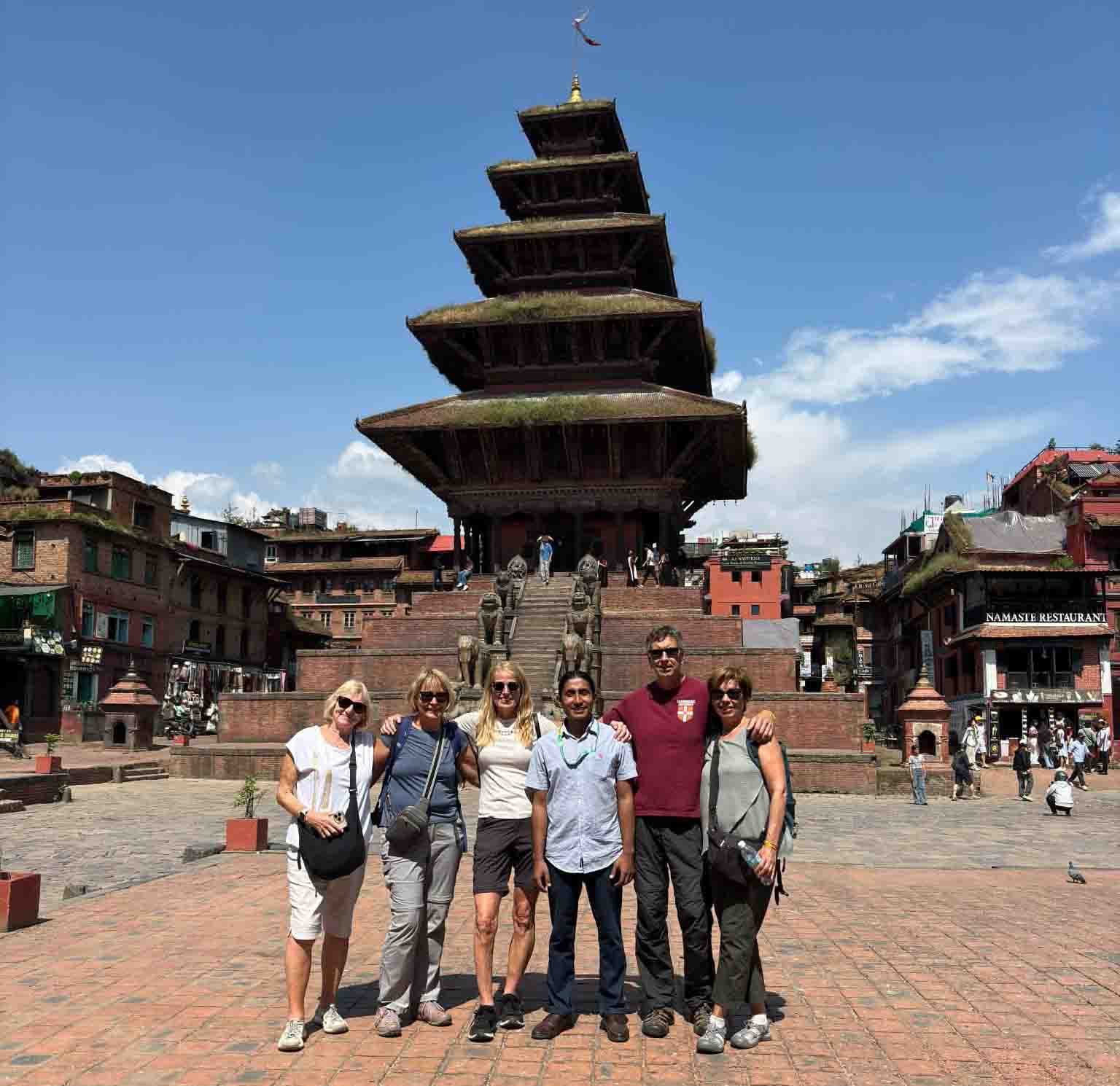
From there, we walked to Taumadhi Square and the Nyatapola temple: five tiers of roofs rising above the square, the tallest temple in the Kathmandu Valley, built more than three hundred years ago. On its steep stone staircase stand pairs of guardians, from wrestlers and elephants up to the gods themselves, each pair said to be ten times stronger than the pair below.
We took a group photo on the steps: five Canadians and their Nepali guide, all smiling, the temple rising behind us. Some photographs are not about art at all; they are about remembering who you were with.
Dattatreya, and tired eyes
We continued to Tachupal Square and the Dattatreya temple, one of the oldest parts of Bhaktapur. Nearby is the famous Peacock Window, a masterpiece of Newar woodcarving: a peacock spreading its tail in a single carved window.
But I could see my guests were tired. The early mountain flight was catching up with them, and they were not very interested in the woodcarving. That is a guide’s lesson too: you cannot make someone love what you love. You read the faces, you shorten the stop, you move on, and you save their energy for what is still ahead.
The man who looked at the sky
All day, I noticed that the one man in the group kept looking up. Whenever large birds circled above us, he stopped and followed them with his eyes, watching how they turned and glided. They were eagles, circling over the valley.
Later in the day, he showed me a picture on his phone: a small aeroplane he had built himself, when he was twelve years old. Suddenly I understood. He wasn’t just watching birds. He was watching flight itself, the way an engineer and a dreamer watches it. It is one of my favourite things about guiding: every guest carries a whole life with them, and sometimes, if you are patient, they let you see a little of it.
Lunch above Boudha
We drove on to Boudhanath, and the mood changed completely.
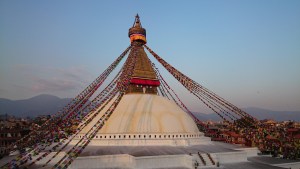
Boudha is one of the largest stupas in the world, a great white dome crowned by the painted eyes of the Buddha, looking out in four directions. Around it, people walk clockwise all day long: monks in red robes, old women with prayer beads, families, travellers. The air is full of the low hum of chanting and the turning of prayer wheels. After eleven days in Bhutan, my guests felt at home here at once.
We had lunch on a rooftop restaurant facing the stupa. Sitting there, resting, eating, looking out at the white dome and the prayer flags, they came back to life. After lunch they walked the circle around the stupa and bought singing bowls to take home to Canada. The deep, long sound of a bowl is a beautiful thing to carry home from Nepal.
I noticed how much happier they were as the day went on. Sometimes a day needs time to open, just like a walk in the mountains.
Pashupatinath: life, death and monkeys
Our last stop was Pashupatinath, the most sacred Hindu temple in Nepal, on the banks of the Bagmati River. Only Hindus may enter the main temple, but visitors can walk the riverbanks and the temples around it.
My guests were not very interested in the temples themselves. What drew them, as it draws almost every visitor, was the cremation ghats along the river, where Hindu families bring their loved ones for the last rites. Smoke rises from the platforms; families gather; the ashes are given to the river, which flows on to the holy Ganges.
They had many questions, and good ones: why by the river, why fire, what the family does, what happens after. I answered as well as I could.
And then the monkeys arrived, jumping across the temple roofs, stealing food, chasing each other along the steps. My guests loved them. Suddenly one of the women turned to me and asked, very seriously:
“Rujan, where do the monkeys sleep at night?”
I thought for a moment and said: “I don’t know. I have never been to Pashupatinath at night.”
We laughed so much. They laughed, and I laughed even more. On the banks of a river where people say goodbye to their loved ones, we stood laughing about monkeys. Maybe that is Pashupatinath too: life and death side by side, and the monkeys running between them.
From strangers to family
It was a long day. We started at ten in Thamel and finished in the late afternoon at Pashupatinath: Bhaktapur, Pottery Square, Nyatapola, Dattatreya, Boudha and the river, all in one day, after an early flight past Everest.
On the way back, the van was quiet. Then one of my guests, sitting in the very last seat, said something I will not forget. They said we had become like family.
That morning, we were strangers in a hotel lobby. I had told them I didn’t have fancy English, only an honest heart. By the evening, after the potters and the eagles, the singing bowls and the monkeys, we were family.
If you visit temples and shrines in Nepal, my guide to Nepal trekking etiquette has simple advice on respect that applies in the cities too.